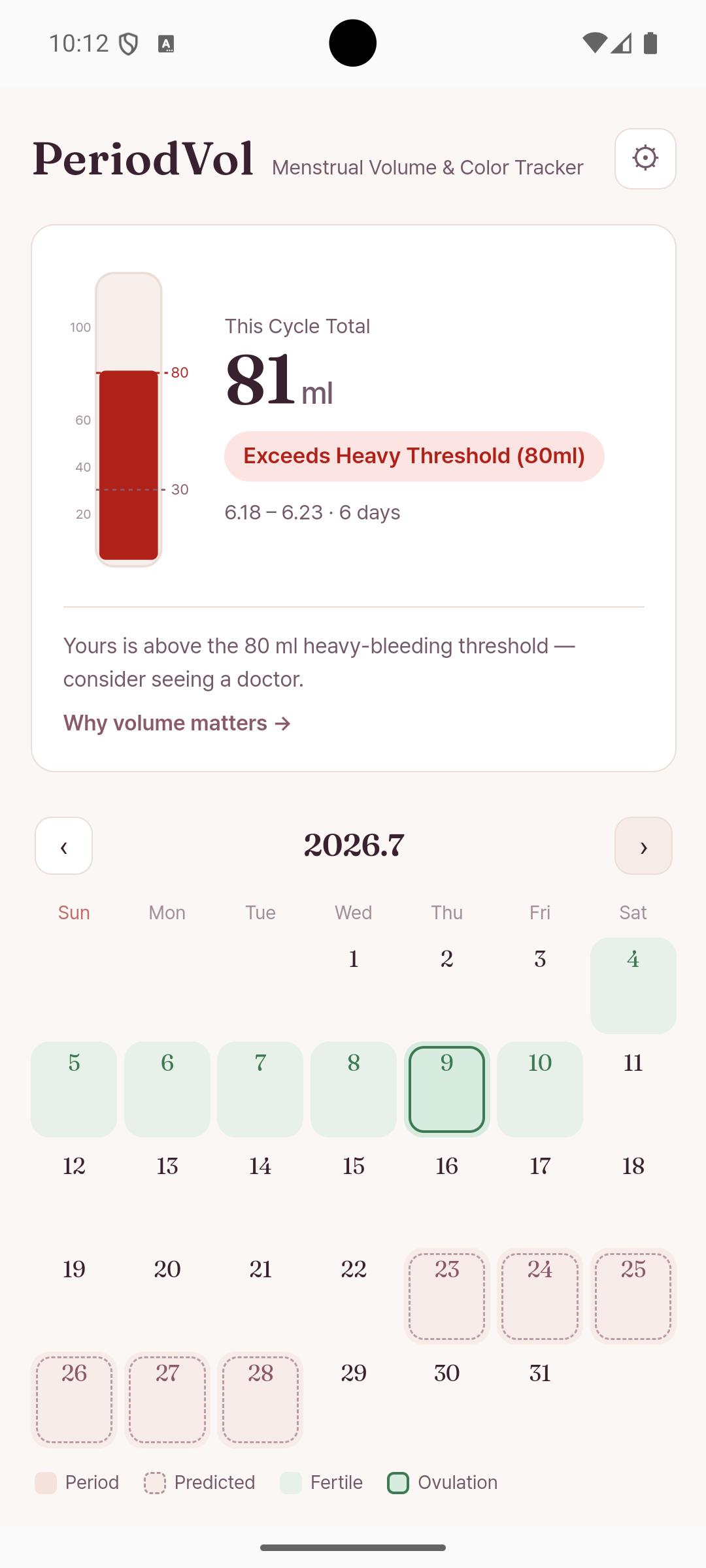
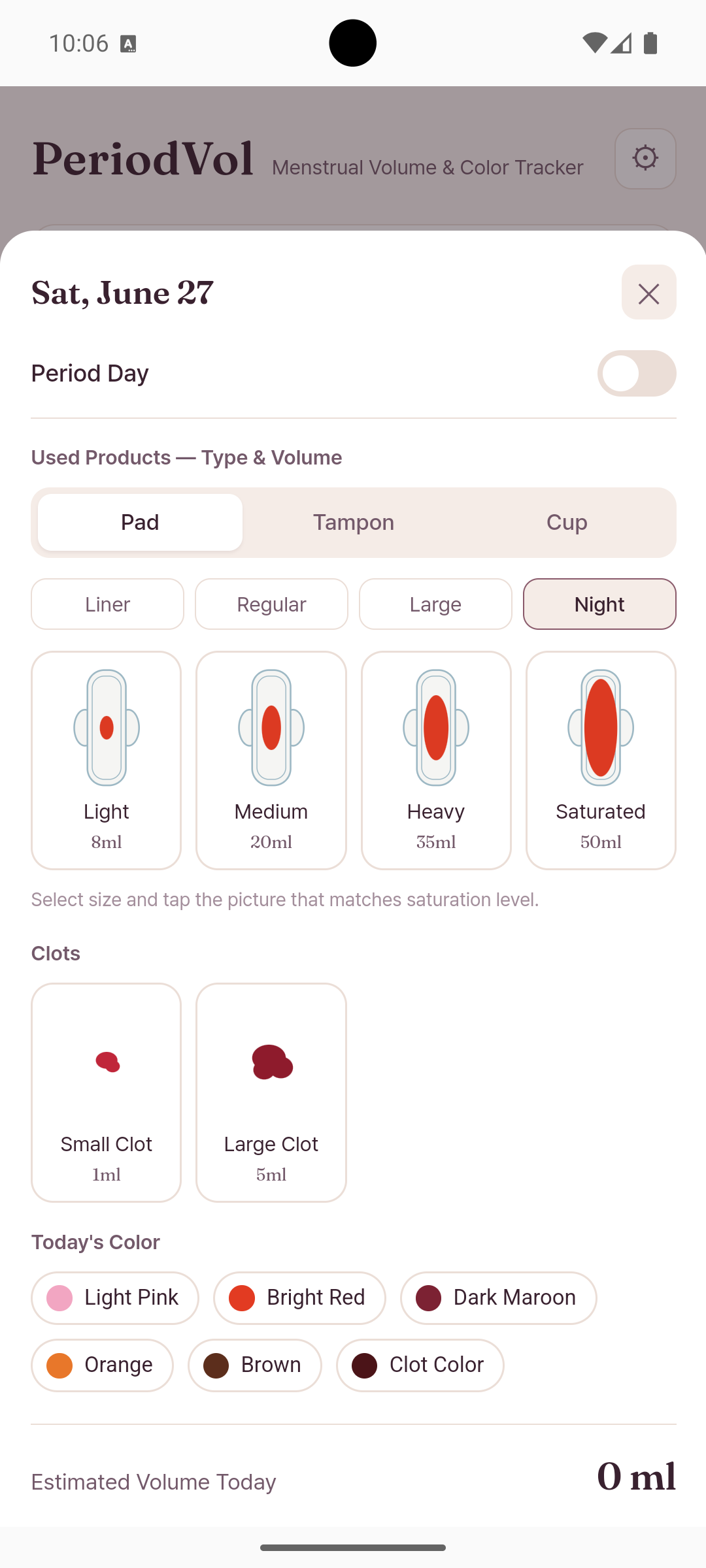
"Are your periods heavy?" is the question doctors ask when your iron runs low — and the paper Pictorial Blood Loss Assessment Chart is how they find out. PeriodVol does that counting for you: log the pads, tampons and cups you use, and it gives you a PBAC-equivalent score and an estimated volume in millilitres, shown against the 80 ml line used to define heavy menstrual bleeding (HMB). Estimates — not a diagnosis.
Or try it right here in your browser →From your first period to menopause you'll bleed around 450 times across nearly 40 years — yet hardly anyone measures how much. Earlier first periods and later pregnancies mean longer lifetime exposure to oestrogen — and uterine conditions keep rising. Gynaecologists classify the causes of abnormal bleeding with a standard system, PALM-COEIN, and the first signal is almost always a change in how much you bleed, or bleeding between periods.
20–30% of women of reproductive age — up to 70–80% by their 50s. Submucosal fibroids can drive a dramatic jump in flow even when small.
The uterine wall thickens and can't contract to stop bleeding well — causing heavier flow and severe cramps.
An abnormally thick lining means heavier flow and bleeding between periods. One of the top gynaecologic cancers — and rising.
The opposite signals too: very light flow or months without a period can point to an ovarian or uterine condition.
Endometriosis affects around 10% of women of reproductive age and is a leading cause of infertility — increasingly diagnosed in women in their early 20s. Regular check-ups matter even without symptoms.
Don't wait if… you soak through a pad in 1–2 hours, pass large clots often, bleed for more than 8 days, or your flow has more than doubled — especially alongside fatigue, dizziness, breathlessness or pale skin (signs of anaemia). Ask for a gynaecologic ultrasound.
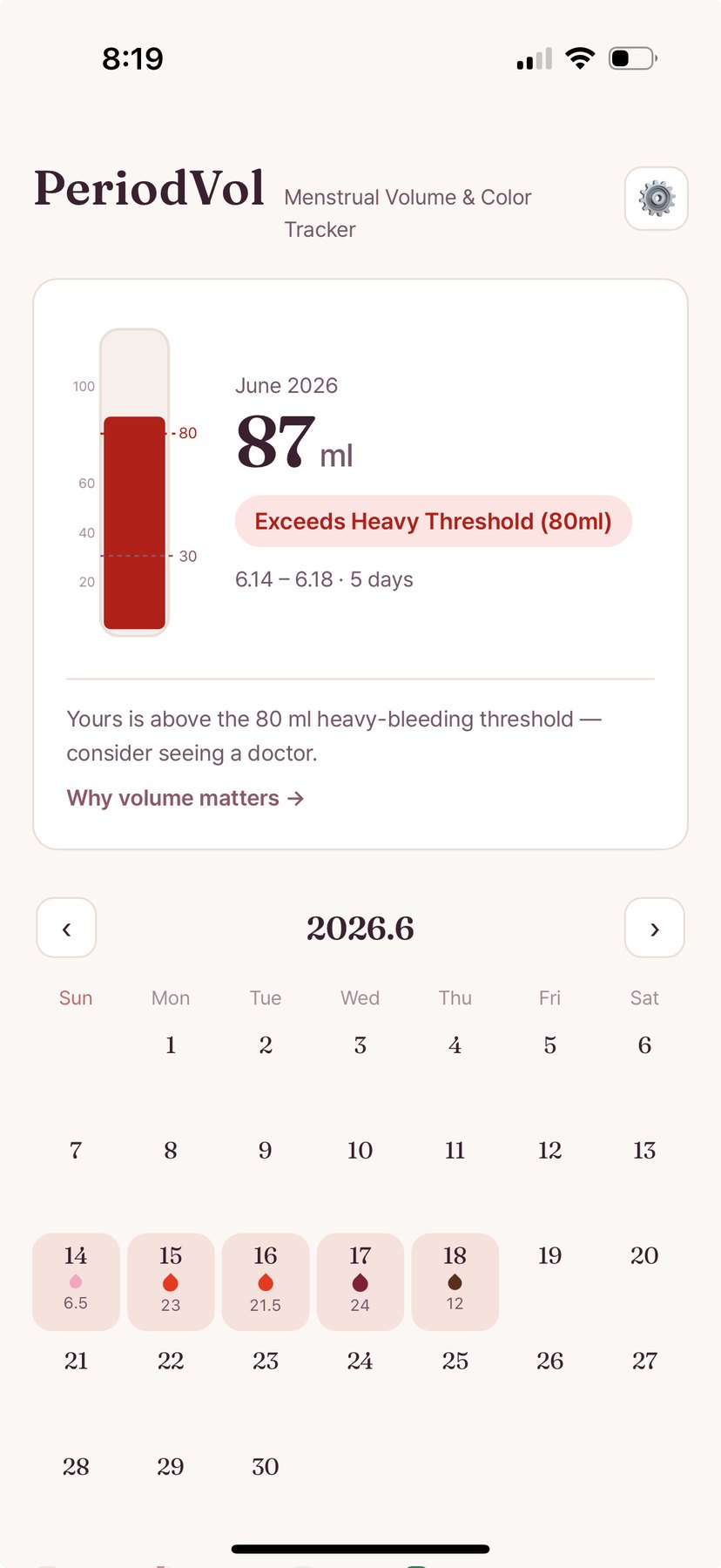
From a quick daily tap to a number you can finally show a doctor.
“Before my iron infusion, the haematologist asked: ‘Are your periods heavy?’ I had no idea — and nothing to show her. So I built PeriodVol to turn my flow into a number I could bring to a doctor.”
Logging takes seconds — PeriodVol does the millilitre math for you.
A pad (by size & how soaked), a tampon, or a menstrual cup (by capacity & fill). Add clots or flooding too.
Each product becomes an estimated volume. Your day and whole-cycle total add up automatically.
A cylinder marks the 80 ml line. Cross it and PeriodVol flags it — so you can talk to a doctor with real numbers.
Clinicians estimate flow with paper charts (the PBAC). PeriodVol is the only consumer period app we know of that turns what you log into estimated ml — automatically.
The clinical line where bleeding is defined as heavy (HMB). PeriodVol marks it so you can see where your cycle sits — a line, not a verdict.
After a few cycles, your next period, ovulation & fertile window — right on the calendar.
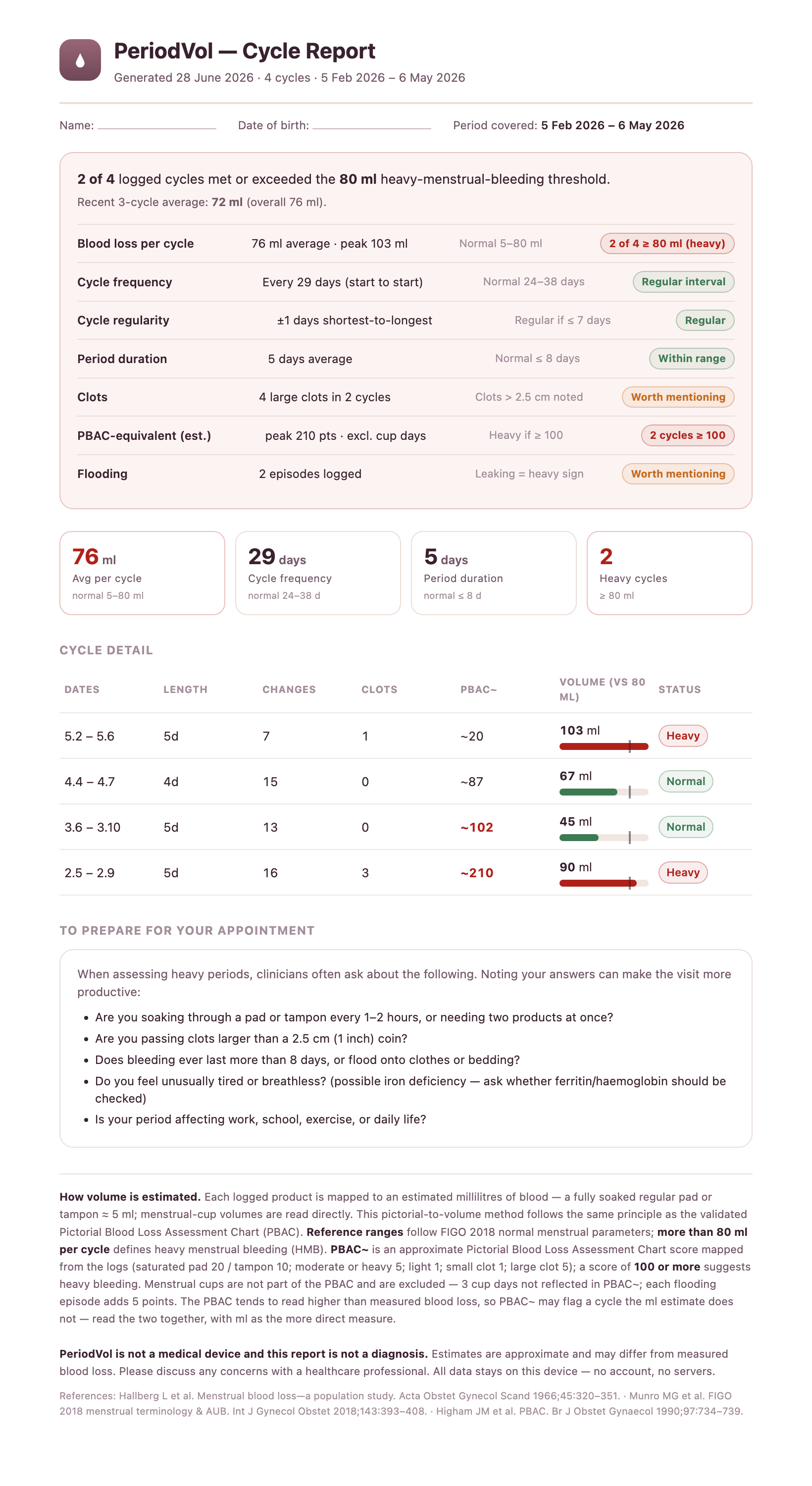
A printable cycle summary with FIGO ranges & a PBAC-equivalent score — bring it to an appointment.
The Pictorial Blood Loss Assessment Chart doctors use, counted for you from what you log. 100 or more suggests heavy bleeding (Higham 1990) — a reference line, not a diagnosis.
Core tracking is free on iOS, Android & web. An optional one-time Pro unlocks the doctor report.
Free to start. Estimates, not a diagnosis — but no more shrugging.
Or open the web app →